ARTILLERÍA

.jpg)
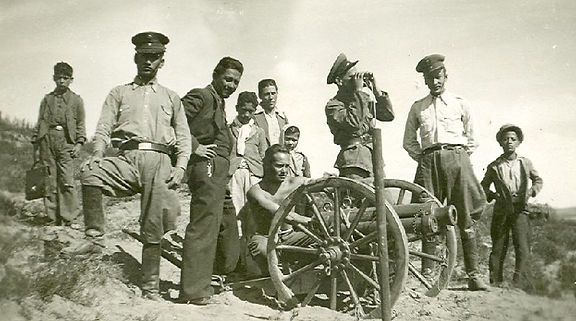
The photo corresponds to the Artillery Group No. 4 "Mariscal Sucre" with a cannon 75mm Vickers of English origin stationed in the Chacras garrison, prior to the 1941 conflict.
He was known in 1860 when he was listed as Artillery Brigade No. 2 Sucre and he engaged in combat defending the city of Guayaquil from positions located in El Salado.
In May 1883, when Colonel Antonio Hidalgo commanded the unit, he moved from Quito to Samborondón; On June 8 of the same year, he arrived in Mapsingue and participated in the war of La Restauración. Indeed, in the part sent by Gral. José María Sarasti to the Provisional Government of Quito, during the aforementioned war against the dictatorship of General Veintemilla, states in one of its paragraphs: “On May 17, 1883, the column of sappers, the Peiger squad, left Yaguachi and arrived at the new camp. and the Sucre artillery ... "
In August 1883 he arrived in the city of Guayaquil with the command and the staff together with the first, second and third firing batteries. In October of the same year, the fourth battery, whose commander was Captain José Álvarez, was increased.
General Alfaro, in his accounts of the 1884 campaign, mentions the Sucre Artillery: “On November 17, 1884, the undefeated Esmeraldas took the barracks by surprise. On November 15, the steamer Santa Lucia sailed from Guayaquil; on the 17th he anchored in Manta and from there he sailed to the bay where the Sucre Artillery embarked to disembark in Esmeraldas ... "
In January 1885, it appears with the name of Artillery Brigade No. 2 in the Plaza de Guayaquil, a name that maintains it until December 1894.
The organic of the unit corresponding to the month of December 1866, according to the commissioner lists was the following: 1 colonel; 1 lieutenant colonel; 1 sergeant major; 5 captains; 9 lieutenants; 4 second lieutenants; 1 surgeon; 1 chaplain; 1 band director; 5 first sergeants; 33 second sergeants; 36 first ropes; 25 second ends; 290 soldiers; 4 cornets and 18 musicians. 1
On August 14, 1895, in the bloody battle of Gatazo, carried out by the government troops under the command of General José María Sarasti and the Liberals commanded by General Eloy Alfaro, the then Mariscal Sucre Artillery Regiment was responsible for acting. The order of operations issued by General Alfaro states: “The right wing was constituted by the Daule Battalion No. 1. In this sector, the Sucre Artillery Regiment will also act, under the orders of its first chief sergeant major Nicolás F. López , who will obey the orders of Colonels Víctor Fiallo and Emilio María Terán, heads of the Artillery Brigade and the respective General Staff, in the order indicated ... ”In the Esmeraldas campaign he was the protagonist of several combats, in which he demonstrated the heroic and warrior unit caste.
In 1896 the Mariscal Sucre Regiment under the command of Major José Miguel Rivadeneira marches towards Cuenca and on August 22 and 23 participates in the battles of Balsay and Cuenca, of which he was victorious. It had its headquarters at that time, in the city of Guayaquil, its headquarters was located on Nueve de Octubre and Escobedo streets.
On January 19, 1906, when the political movement overthrew the government of Mr. Lizardo García, it had an outstanding performance defending the Constitution of the Republic. In 1910, when Peru threatened to invade our country, the Mariscal Sucre Artillery Regiment was ready to defend the Homeland, advantageously there was no such invasion:
Peru did not venture to challenge the patriotism and determination of a threatened people.
In November 1913, under the command of Major Francisco Orellana, Captain Ricardo Noboa and Lieutenant Luis Paredes, participated in the Guayabo battle. A section of the regiment, commanded by Captain Miguel A. Pérez, acted in the action de Camarones, on April 12, 1914. One piece, under the command of Lieutenant José E. Mena, supported the actions of La Propicia; a fraction of the same regiment left for Esmeraldas where they took charge of the following equipment: a Wikers-Maxims battery, a Skoda battery, an Ehrhardt section and a Hotchkiss M1914 machine gun section. With this material he protected the landing of the constitutionalist forces on Bambuco Island, on July 30, 1914.
On August 18 of the same year, he participated in the two battles in La Boca, actions of arms from which he emerged triumphant.
A fraction of the troops of the Artillery Regiment No. 2 Sucre under the command of Captain Miguel A. Pérez, is busy unearthing the historic Salado canyons and the old castle of Las Cruces that provided so many important services to our colonial Guayaquil, at the time of the pirates. Said cannons are going to be destined to adorn the column of the unknown heroes ”. 2
In January 1912, in the fighting in Huigra, Naranjito and Yaguachi, the Sucre Artillery Regiment had to fight, unfortunately, against another artillery unit, the Bolívar Regiment, when the government troops under the command of Generals Leónidas Plaza Gutiérrez and Julio Andrade, they faced the forces of the coast, commanded by the generals Pedro Montero and Flavio Alfaro.
Until 1925, the Sucre Regiment had its garrison in Guayaquil. In September of the same year, he moved to the city of Quito, until he received the order to move to Riobamba. Precisely, from this city he would march towards Quito, forming part of the Army of the South, during the so-called War of the Four Days (from August 29 to September 1, 1932). The Mariscal Sucre and Calderón regiments had to fight against the Bolívar Artillery Regiment and the other military units that opposed Bonifaz's disqualification.
In 1936, it was called the Mariscal Sucre Mountain Artillery Group No. 3 and was stationed in Latacunga, commanded by Lieutenant Colonel Cristóbal Espinoza. He had three shooting batteries, a combat train, a hundred mules, and thirty horses.
In 1937 the group returned to Guayaquil. During the international campaign of 1941, the 1st firing battery was in Santa Rosa, under the command of Lieutenant Colonel Jorge Maldonado Toledo. “Unfortunately he did not fight with his artillery material: he did it as infantry, because the material available at the border was outdated, with incomplete elements and without enough ammunition. There were also no livestock available for transport ... Breda 20mm antiaircraft artillery pieces had a very limited range and their ammunition endowment was very low. His use was almost symbolic. "
However, two pieces of Breda antiaircraft artillery with all their servants intervened in the naval combat of Jambelí, commanded in the Calderón gunboat, which had to protect the motor ships that transported reinforcements and supplies to the units of the province of El Oro. 3
Once again, the unit returns to the capital. The Mariscal Sucre camp located in the El Pintado citadel in the city of Quito, in the 60s of the previous century, fraternally welcomed the paratrooper battalion. His work in collaboration with citizens was always recognized, especially in the south of the city. Thousands of young students who did the pre-military recall with gratitude the novel experiences lived in the El Pintado barracks.
To have greater functionality, and to free the teaching field from administrative and instructional tasks, the Artillery School No. 13 Mariscal Sucre was created.
The patriotic and virile presence of Marshal Sucre, unfortunately, was not exempt from internal rebellions and riots. The Balbina rebellion of General Jácome Chávez, in March 1971; that of General Raúl González Alvear, in 1975; that of General Frank Vargas Pazzos, in 1986; they relived the painful episodes of yesteryear.
In 1991, Grupo Escuela Nº 13 Mariscal Sucre moved to the facilities of the Atahualpa Military Fort, in Machachi (Aychapichu), where it remains to this day. From there once more, in 1995, he marched to the border and took up his positions in the province of El Oro, safeguarding the territorial integrity.
1. Crnl. YM Larenas, National Army Magazine, year 1, No. 6, 1922.
2. The National Army Magazine, No. 6, 1922.
3. Larrea Alba, Luis. The 1941 campaign.